Template
Business case templates
A business case helps someone decide whether a project, purchase or change is worth doing.
Download the template


Download everything
All 2 versions, in Word and PDF, in one ZIP file (870 KB).
More free templates from elsewhere
Free resources from other websites - we check these links regularly.
-
 Business justification case template, medium cost and risk (Word)
Opens on GOV.UK (HM Treasury Green Book)
(external site, opens in a new tab)
-
 Outline business case template with guidance (Word, local energy projects)
Opens on Local Partnerships (HM Treasury and LGA owned)
(external site, opens in a new tab)
-
 Strategic outline case template with guidance (Word, local energy projects)
Opens on Local Partnerships (HM Treasury and LGA owned)
(external site, opens in a new tab)
-
 Green Book appraisal summary tables (Excel)
Opens on GOV.UK (HM Treasury Green Book)
(external site, opens in a new tab)
How to use it
- Choose the two-page template for a bigger decision, or the one-page version for a small one.
- Fill in the problem and the options first, including "do nothing" so the baseline is clear.
- List every cost and benefit by year, using quotes or past bills where you have them.
- Work out when the costs are recovered and note your main assumptions.
- Write the summary and recommendation last, then ask the decision maker to sign.
About this template
These two free templates set out the problem, the options, the costs and benefits over time, the risks and a clear recommendation. Use the two-page version for larger decisions such as new equipment or a committee spend, and the one-page version for quick decisions inside a small team. Each comes blank and with a filled-in UK example, so you can see how the figures fit together. Download as Word to edit or PDF to print.
Questions
What should a business case include?
At minimum: the problem or opportunity, the options you looked at, what each costs, what you expect to get back, the main risks and your recommendation. These templates cover all of that in a fixed order.
How long should a business case be?
As short as the decision allows. One page is enough for a small purchase. Two pages suits a larger spend. Attach quotes or supporting figures separately instead of adding more pages.
Can I use the worked example numbers?
No - they are made up to show the layout. Replace every figure with your own.
Does this give financial advice?
No. The templates help you organise information. For tax, accounting or investment questions ask a qualified adviser, and see GOV.UK for official business guidance.
Related templates
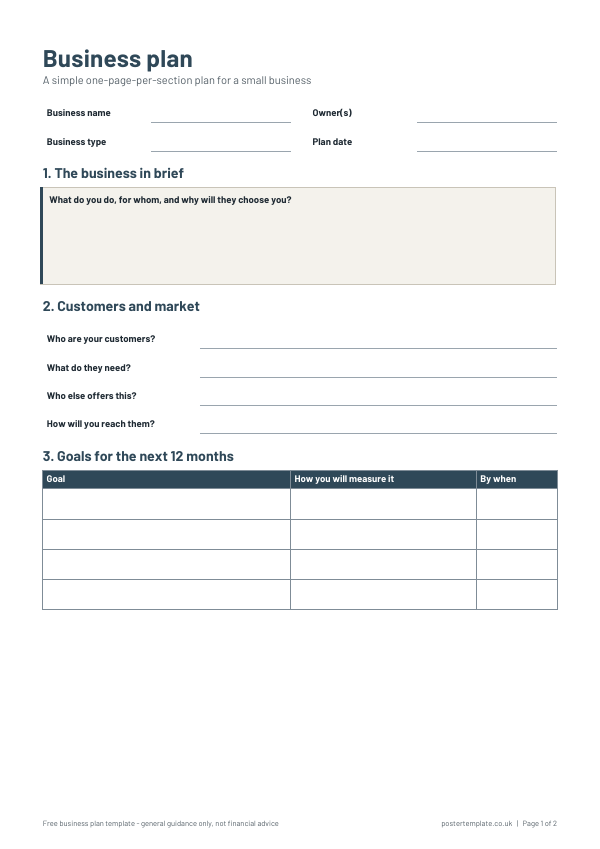 Business planning templates
 Cost benefit analysis templates
 Project proposal templates
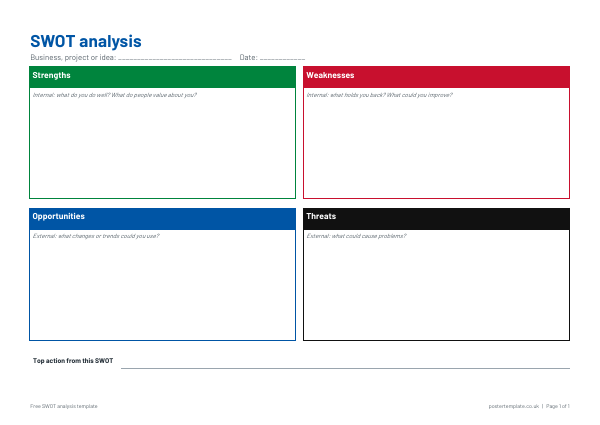 SWOT analysis templates
Free, no sign-up. Edit the Word file or print the PDF. All templates